
5 Questions a Day · Year 6
Five short questions every weekday, right up to the assessments. A few focused minutes of Maths, English and Reasoning each day builds confidence and keeps skills sharp, without adding hours of extra work.
Dates
26th Oct – 13th Nov 2026
Each weekday
5 questions
Submit by
Midnight each day
Three simple steps, every weekday for three weeks.
1
Complete today's five multiple-choice questions before midnight. It only takes a few minutes.
2
Come back the next weekday at 10am to see the answers and explanations.
3
Fifteen daily sets over three weeks. Little and often builds confidence before the Pre-Tests.
Every daily set includes
2
Maths
One arithmetic question and one word problem
2
English
Spelling, punctuation and grammar, plus vocabulary
1
Reasoning
Alternating verbal and non-verbal reasoning
Answer all five questions and submit before midnight (UK time). Each day, enter the same first name and parent or guardian email so we can count your completed sets. Only your first submission each day counts.
After you submit
You'll see a confirmation message on screen. That means your answers have been received.
When are the answers out?
Answers and explanations are published below the next weekday morning at 10am.
Each set's answers are published the next weekday morning at 10am. Tap a day to see how each question is solved.
Week 1
Answers will be published on Tuesday 27 October.
What is 32% of 75?
Solution
32% of 75 is the same as 75% of 32, because percentages are reversible (both mean 32 × 75 ÷ 100). 75% = ¾, and ¾ of 32 = 24.
Tap A can fill a tank in 20 minutes, and Tap B can fill the same tank in 30 minutes. A drain can empty a full tank in 60 minutes. The tank is initially half full. Both taps and the drain are then opened together. How long will it take to fill the tank completely?
Solution
Look at all the rates in terms of 60 minutes:
Altogether, A + B – Drain = 3 + 2 – 1 = 4 tanks in 1 hour. So 1 tank takes ¼ hour (15 minutes), and ½ a tank takes ⅛ hour (7.5 minutes). One tankful takes 15 minutes, so half a tank takes 7 minutes 30 seconds.
Which word is spelt incorrectly?
Solution
The correct spelling is occurrence, with a double c and a double r.
Meticulous is closest in meaning to:
Solution
Meticulous means showing great attention to detail. Fussy is close, but suggests being hard to please, which isn't quite the same thing.
Which word has a similar meaning to BOTH sets of words? (hide, conceal) (unclear, dubious)
Solution
As a verb, obscure means “to hide or cover”. As an adjective, it means “confusing or rare”.
Answers will be published on Wednesday 28 October.
Which fraction is closest to 1?
Solution
Each fraction is exactly one piece away from 1: 31/32 is 1/32 below 1, 42/41 is 1/41 above 1, and so on. The bigger the denominator, the smaller the piece, so 73/74, only 1/74 away, is closest. Being above 1 doesn’t matter; only the size of the gap does.
A floor has 6 rows and 5 columns of square tiles. A rectangular mat covers exactly 2 rows by 3 columns of tiles, and it may be turned by 90°. In how many different positions can the mat be placed so that it exactly covers whole tiles?
Solution
Unturned (2 rows tall, 3 columns wide), its top edge can be on rows 1 to 5 and its left edge on columns 1 to 3, so there are 5 × 3 = 15 places it can be on the floor.
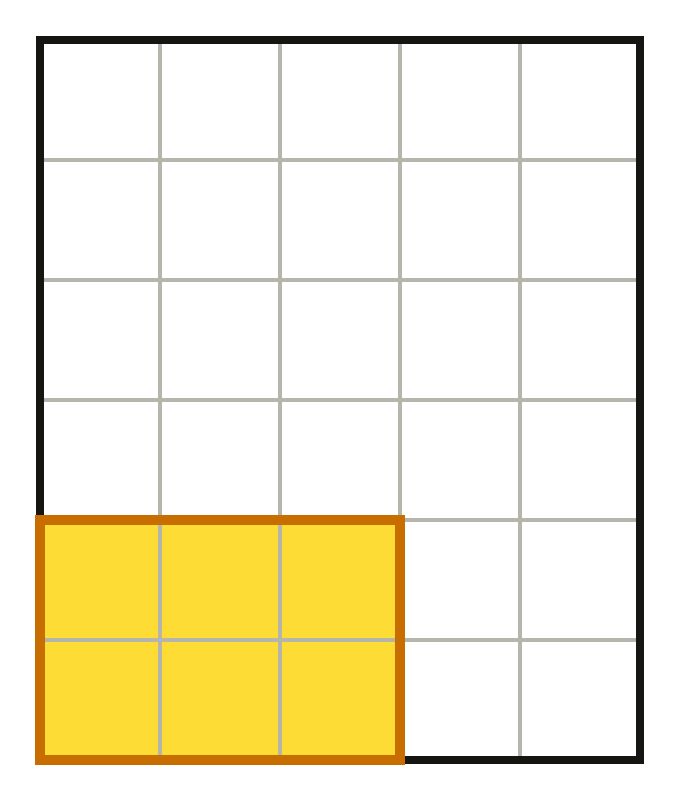
When turned 90°, the mat is 3 rows tall and 2 columns wide. Its top edge can be on rows 1 to 4 and its left edge can be on columns 1 to 4, so there are 4 × 4 = 16 places it can be on the floor.
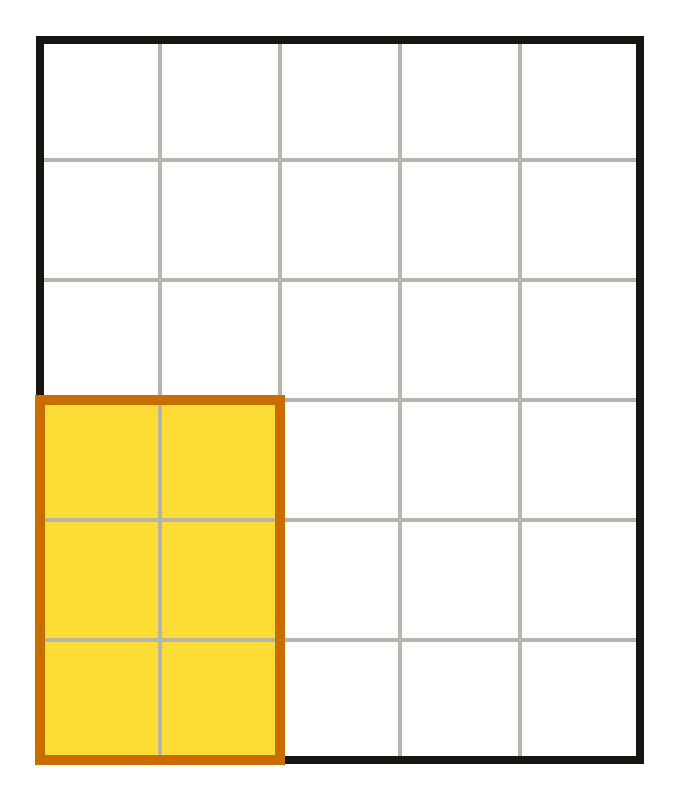
In total, there are 15 + 16 = 31 ways to position the mat on the floor.
Which sentence makes it clear that Jacob was crossing the street?
Solution
Only this sentence clearly makes Jacob the person crossing. In the others, the cat is crossing or Jacob is on the pavement; “Jacob watched the cat crossing the street” most naturally means the cat is crossing.
The old clock had not chimed for years, yet every night Grandpa still wound it. Why does Grandpa continue winding the clock?
Solution
The clock hasn’t chimed for years, yet Grandpa still winds it. The word yet suggests he does it out of habit or fondness rather than to hear it chime.
One letter completes the first word and begins the second word. ABSOR (?) OUGH
Solution
The letter B completes ABSORB and begins BOUGH.
Answers will be published on Thursday 29 October.
What is the ones digit of 7 × 17 × 27 × 37 × 47 × 57?
Solution
Only the ones digits matter, and every number ends in 7, so keep multiplying ones digits by 7. 7 × 7 = 49, which ends in 9. Then 9 × 7 = 63 ends in 3, 3 × 7 = 21 ends in 1, 1 × 7 = 7 ends in 7, and 7 × 7 = 49 ends in 9 again. That is six 7s multiplied together, so the answer ends in 9.
A pupil starts a quiz with 0 points. Each correct answer earns 9 points, and each incorrect answer loses 6 points. After answering eight questions, the pupil has 42 points. How many questions did the pupil answer correctly?
Solution
If all eight answers were correct, the score would be 72. Changing a correct answer into an incorrect one decreases the score by 15 points. 72 – 42 = 30 points, so 30 ÷ 15 = 2 answers were incorrect. Therefore, 6 answers were correct.
Rearrange the words below to make a meaningful sentence. One word will not fit. carefully · praised · worked · the · for · artist · working · was. Which word does not fit?
Solution
The sentence is “The artist was praised for working carefully.” The word worked does not fit.
Despite the warm welcome, the ambassador’s remarks were ______, avoiding any definite promises. Which word best completes the sentence?
Solution
Guarded means cautious or deliberately restrained. The ambassador avoided definite promises rather than speaking openly, forcefully or joyfully.
The kumquats were abundant this year, so Gus could make pies for his community. What does abundant mean?
Solution
Abundant means plentiful.
Answers will be published on Friday 30 October.
How many whole numbers from 1 to 100 inclusive have exactly three different positive whole-number factors?
Solution
Only squares of prime numbers have exactly three factors. For example, 25 has factors 1, 5 and 25: the 5 pairs with itself, and because 5 is prime, there are no others. (36 has many more because 6 is not prime.) Since the question asks for numbers from 1 to 100 inclusive, we need the squares of prime numbers that are less than 10, i.e. 2, 3, 5, 7. Their squares are 4, 9, 25 and 49, so there are 4.
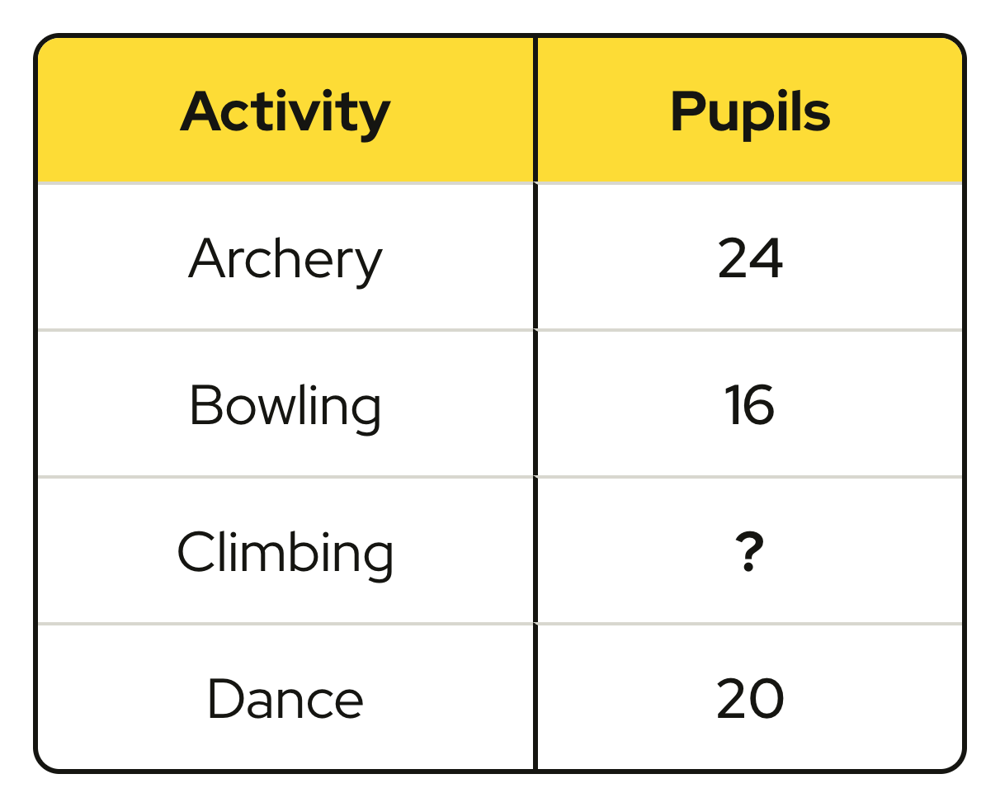
The table below shows how many pupils chose four activities. Eight pupils change their choice from Archery to Climbing. After this change, exactly one-third of all pupils have chosen Climbing. How many pupils originally chose Climbing?
Solution
After the change, Archery has 24 − 8 = 16, Bowling still has 16 and Dance still has 20. Together that is 52 pupils, which is two-thirds of everyone.
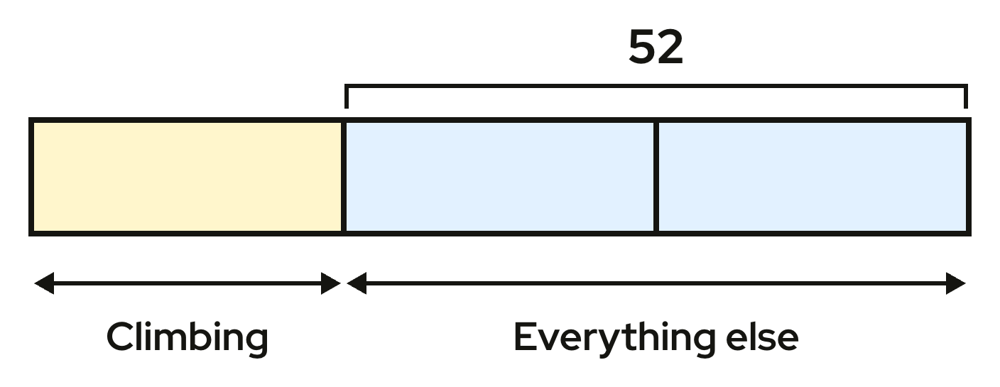
So, one-third is 52 ÷ 2 = 26, so Climbing now has 26 pupils. Before the 8 moved across, Climbing had 26 − 8 = 18.
Which sentence is punctuated correctly?
Solution
The exclamation mark goes inside the speech marks, and shouted stays lower case because the sentence continues. “We’ll be late!” is a new sentence, so it follows a full stop and begins with a capital letter.
At the end of the exhibition, Isla paused at the noticeboard to read every prize winner’s name. When her friend asked whether she was disappointed, she replied, “Not particularly,” then quietly began packing away her brushes. What is most strongly suggested about Isla?
Solution
Reading every winner’s name shows the results matter to her, despite her claim. Quietly packing away suggests she doesn’t want to talk about how she feels.
Choose the pair of letter strings that completes BOTH words. ru___e trou___
Solution
BBL completes RUBBLE and GHS completes TROUGHS.
Answers will be published on Monday 2 November.
A number is increased by 20%. The result is then decreased by 20%. What fraction of the original number remains?
Solution
Start with 100: increasing by 20% gives 120, then reducing 120 by 20% takes off 24, giving 96. The fraction remaining is 96/100 = 24/25. It isn’t 1, because the 20% taken off is 20% of a bigger number.
At 2:50, what is the smaller angle between the hour hand and the minute hand of a clock?
Solution
Each hour on a clock is 360° ÷ 12 = 30°. From the 10 (where the minute hand points) to the 2 is four hour-gaps of 30°, which is 120°.
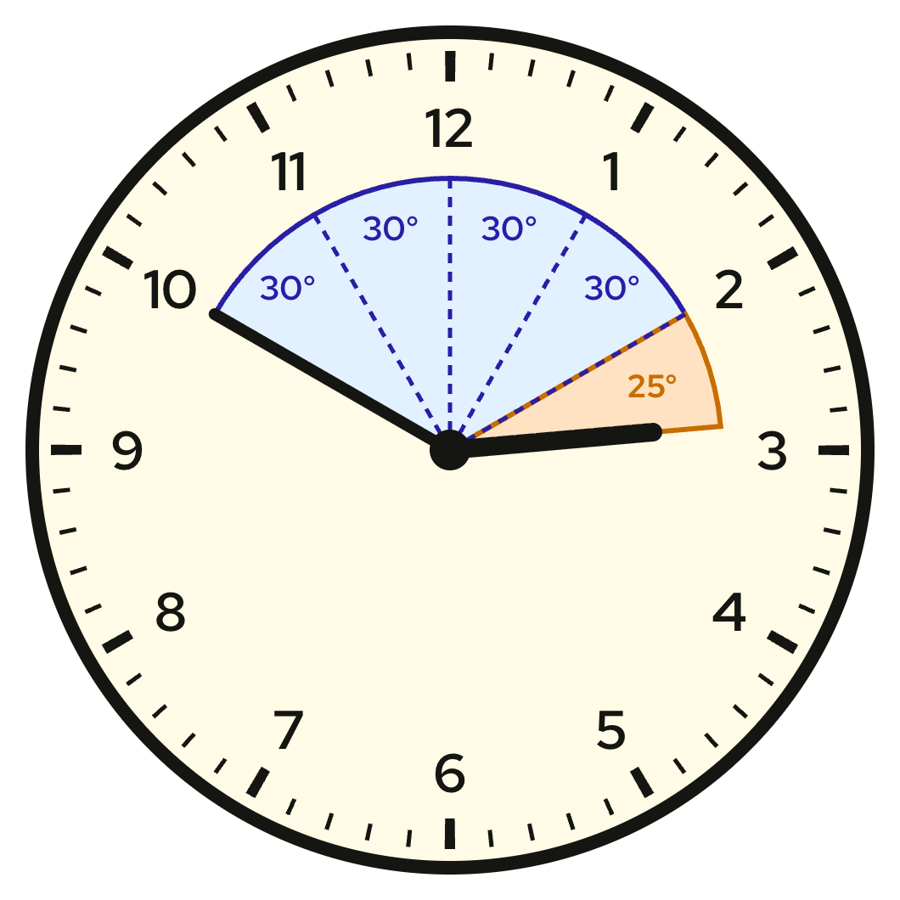
But the hour hand has also moved 50/60 of the way from 2 to 3, which is 5/6 of 30° = 25°. So, the angle is 120° + 25° = 145°.
How many words in the sentence below should begin with a capital letter? last tuesday, my cousin and i visited the natural history museum in london.
Solution
The seven words are Last (start of the sentence), Tuesday, I, Natural, History, Museum and London. Days of the week, the word I, and every word in a proper name take capitals.
The snake slid silently through the silver grass, its scales softly brushing the stones. Which of the following is NOT an effect of the repeated ‘s’ sounds?
Solution
The repeated ‘s’ sounds create sibilance, suggesting hissing and smooth, quiet movement rather than abrupt force.
If the code for STEEP is TUFFQ, what does DBMMT mean?
Solution
Each letter of the word moves forward one place in the alphabet to make the code (S→T, T→U, E→F, E→F, P→Q). To decode, move each letter back one place: D→C, B→A, M→L, M→L, T→S, which gives CALLS.
Week 2
Answers will be published on Tuesday 3 November.
All the integers from −15 to 20 inclusive are added together, but one number is accidentally left out. The total is 98. Which number was left out?
Solution
The integers from −15 to 15 cancel in positive-negative pairs, leaving 16 + 17 + 18 + 19 + 20 = 90. But the total is 98, which is 8 greater. Therefore, −8 must have been left out.
(8 cannot be the number that is left out, because then −8 would be left, so the total would be 82.)
A square courtyard is surrounded by a path exactly 2 m wide on every side. The path covers an area of 80 m². What is the perimeter of the courtyard itself?
Solution
Split the path into four 2 m × 2 m corner squares (16 m² altogether) and four strips, each 2 m wide and as long as one side of the courtyard.
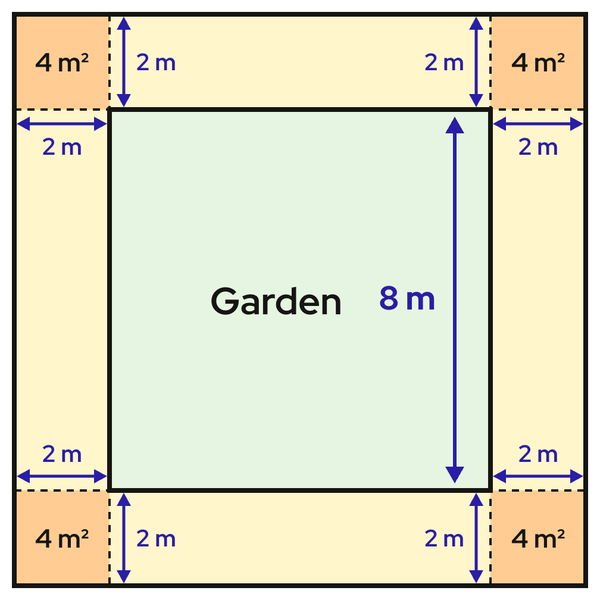
The strips make 80 − 16 = 64 m², so each strip is 16 m², and the courtyard side is 16 ÷ 2 = 8 m. Perimeter: 4 × 8 = 32 m.
What type of phrase is “The unusually quiet crowd outside the theatre” in the sentence below? The unusually quiet crowd outside the theatre stood still.
Solution
The whole group of words is a noun phrase, with crowd as its main noun. The other words tell us more about the crowd.
Despite the glowing reviews, Theo remained sceptical about the new invention. Which action would best demonstrate his scepticism?
Solution
Being sceptical means doubting something until there is convincing evidence. Asking for proof shows scepticism without assuming the invention is a failure.
Arrange these lengths from longest to shortest. Which unit is THIRD?
Solution
From longest to shortest: kilometre, metre, decimetre, centimetre, millimetre. A decimetre is 0.1 of a metre and a centimetre is 0.01 of a metre, so the decimetre comes third.
Answers will be published on Wednesday 4 November.
An area of 0.08 m² is compared with an area of 750 cm². By how many square centimetres is the first area larger?
Solution
1 m = 100 cm, so 1 m² = 100 cm × 100 cm = 10,000 cm², not 100 cm². So, 0.08 m² = 0.08 × 10,000 = 800 cm², and 800 − 750 = 50 cm².
Pens cost 35p each and pencils cost 20p each. Sam spends exactly £2 and buys at least one of each. How many pencils does he buy?
Solution
Pencils always cost a multiple of 20p, so the pens must cost a multiple of 20p too. 1, 2 or 3 pens cost 35p, 70p or 105p, none of which is a multiple of 20p, but 4 pens cost 140p. That leaves 200p − 140p = 60p, which buys 3 pencils.
(4 is the number of pens and 7 is the total number of items.)
Which sentence uses dashes correctly to mark extra information?
Solution
The dashes surround “exhausted after the climb”, which adds extra information. Removing this phrase leaves a complete sentence.
Ominous is closest in meaning to:
Solution
Ominous suggests that something bad or threatening may happen. Mysterious is close, but does not necessarily suggest danger.
Which pair of words is closest in meaning?
Answers will be published on Thursday 5 November.
What is -1/4 - 2/6 + 3/8 + 4/12 + 5/10 - 6/16 + 7/8 - 8/16?
Solution
Recognise the equivalent fractions: 2/6 and 4/12 are equivalent, so -2/6 + 4/12 = 0. Similarly, 3/8 - 6/16 = 0 and 5/10 - 8/16 = 0, leaving 7/8 - 1/4 = 5/8.
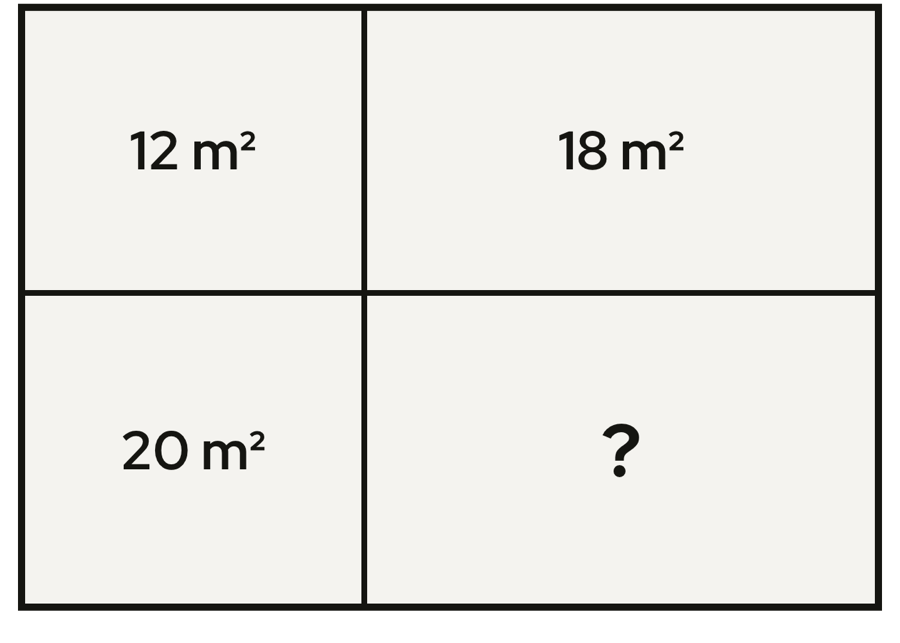
A rectangular garden is divided into four smaller rectangular beds by one horizontal line and one vertical line, as shown. The diagram is not drawn to scale. What is the area of the fourth bed?
Solution
The top two beds have the same height, and 18 m² is 1½ times 12 m², so the right-hand beds are 1½ times as wide as the left-hand ones. The bottom two beds also share a height, so the missing area is 1½ times 20 m² = 30 m².
Which sentence is spelt correctly?
Solution
Independent ends in -ent, not -ant. Committee has a double m and a double t, and consensus is spelt with an s after con, not a c.
Every autumn, thousands of salmon leave the sea and swim upstream towards the rivers where they hatched. Strong currents, waterfalls and predators make the journey dangerous. Those that reach their destination lay their eggs, beginning the next generation.
Which is the best summary?
Solution
This summarises both the purpose of the journey and its dangers, without adding anything that isn’t in the passage.
Read the statements and choose the option that MUST be true. There are 10 girls in Class A.
Jade wears her hair in plaits to school every day except Thursdays, when she only ever wears it in pigtails.
Sophie wears her hair in a bun three days a week, but on a Wednesday and at weekends she always wears it in a ponytail.
Millie will only ever wear her hair in plaits, regardless of what day it is.
Andrea doesn’t like having her hair up, so she always wears it down when she’s at school.
Solution
Note: the question should have said Sophie wears a ponytail on Mondays and Wednesdays, so C is the intended answer.
Answers will be published on Friday 6 November.
What is 88 × 112 + 12 × 12?
Solution
Split 112 into 100 + 12.
Then 88 × 112 = (88 × 100) + (88 × 12)
Notice that (88 × 12) + (12 × 12) = 100 × 12
So, 88 × 112 + 12 × 12 = (88 × 100) + (100 × 12) = 8800 + 1200 = 10,000
When a jar is one-third full of rice, it weighs 1.5 kg. When the same jar is five-sixths full, it weighs 2.7 kg. How much does the empty jar weigh?
Solution
Draw a bar model, including the jar. Split the first into thirds and the second into sixths. Then split each of the thirds into two, making the first bar also into sixths.
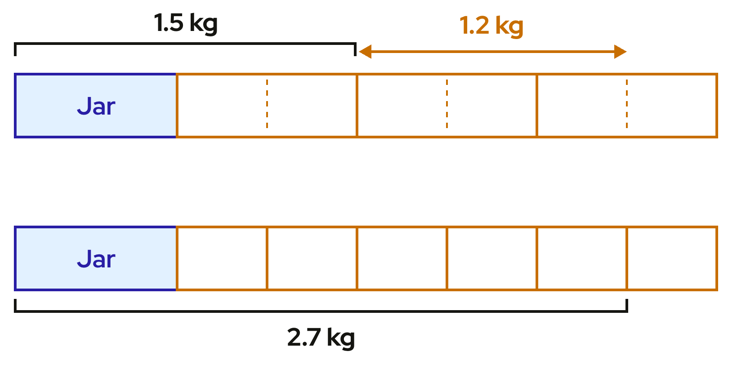
The difference between the two values is 3 equal parts of the bar, representing 1.2 kg.
Then one equal part = 1.2 kg ÷ 3 = 0.4 kg
Two equal parts plus the jar are 1.5 kg, so the jar is 1.5 – (2 × 0.4) = 0.7 kg
How many words in the sentence below need an apostrophe?
The girls coats were hanging in the schools cloakroom, but Ellas wasnt there.
Solution
The four words are girls’ (or girl’s), school’s, Ella’s and wasn’t. Three show possession and one is a contraction.
Which word means to make something less severe?
Solution
Alleviate means to ease or lessen something unpleasant. Aggravate means the opposite: to make it worse.
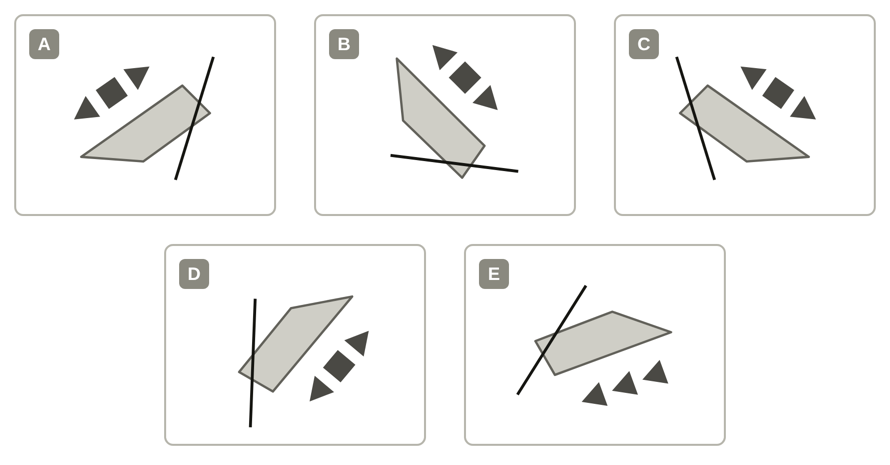
Identify the odd one out by looking at what the images below have in common.
Solution
Note: picture E should have shown two triangles and one square.
Answers will be published on Monday 9 November.
The digits 0, 2, 4 and 6 are each used exactly once to form a four-digit number. How many different multiples of 4 can be made?
Solution
A number is a multiple of 4 if its last two digits make a multiple of 4. So, the possible endings that are multiples of 4 are 04, 20, 24, 40, 60 and 64. For each ending, the other two digits can go either way round, except 0 cannot be first (otherwise it wouldn’t be a 4-digit number).
Four of these endings contain 0. For each of these, the remaining two digits can go either way round, giving 2 possibilities. For example, ending in 04 gives 2604 and 6204. So there are 4 × 2 = 8 possibilities.
If the last two digits do not contain zero and the first digit cannot be zero, the remaining possibilities are 24 and 64, each give just one possibility because 0 cannot be the first digit.
In total, there are 8 + 2 = 10 possibilities.
One-third of the pupils in a school club cycle to school. Twelve of the cyclists leave the club. No other pupils leave or join. Now exactly one-quarter of the club cycles to school. How many pupils were in the club originally?
Solution
Use the block method. In this case, we have a constant part – the number of pupils in the club who do not cycle to school.
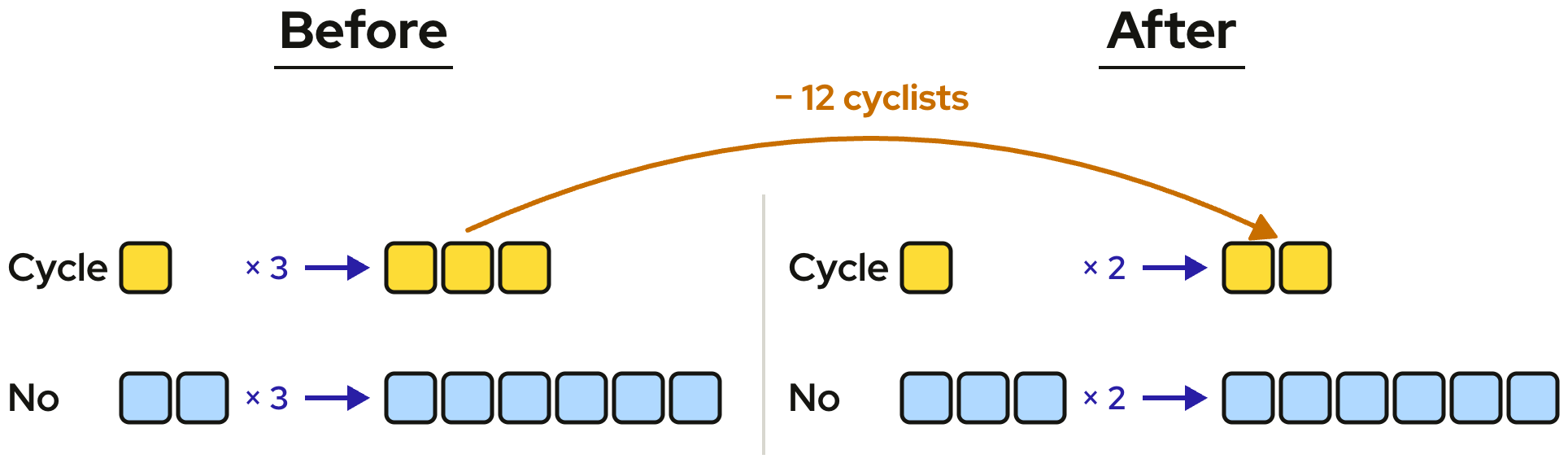
We need the same number of blocks before and after for the pupils who do not cycle to school, so multiply the ‘before’ ratio by 3 and the ‘after’ ratio by 2.
Then the number who cycle before and after differs by 1 block, representing 12 pupils, so [] = 12.
There were 9 blocks in total in the scaled ‘before’ ratio, so there were 9 × 12 = 108 pupils in the club before.
The new curtains ______ the pale green walls perfectly.
Which word correctly completes the sentence?
Solution
Complement means to go well with something, while compliment means to praise. A useful reminder is that a complement completes.
A notice at a school event read:
“Parents should collect children wearing green badges at the main entrance.”
Which word best describes the instruction?
Solution
Ambiguous means open to more than one interpretation. The notice could mean that the parents should wear green badges, or that they should collect the children who are wearing them.
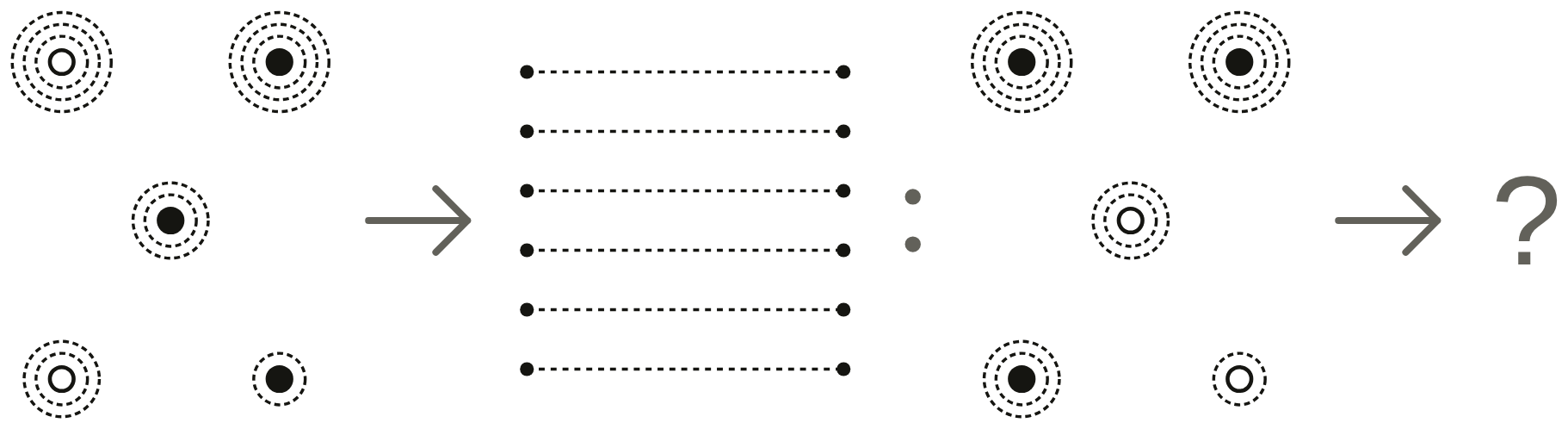
The first image has been transformed to make the second image.
Which of the images below follows the same transformation of the third image?

Solution
The number of rings around the black dots gives the number of dotted lines. In the first image the black dots have 3 + 2 + 1 = 6 rings, making 6 lines. In the third image they have 3 + 3 + 2 = 8 rings, so the answer has 8 lines.
Week 3
Answers will be published on Tuesday 10 November.
What is 6.25 x 48 + 6.25 x 32 -1.25 x 80?
Solution
The first two products both have 6.25, so combine them: 6.25 × (48 + 32) = 6.25 × 80. Now both remaining terms have 80: (6.25 × 80) – (1.25 × 80) = (6.25 – 1.25) × 80 = 5 × 80 = 400.
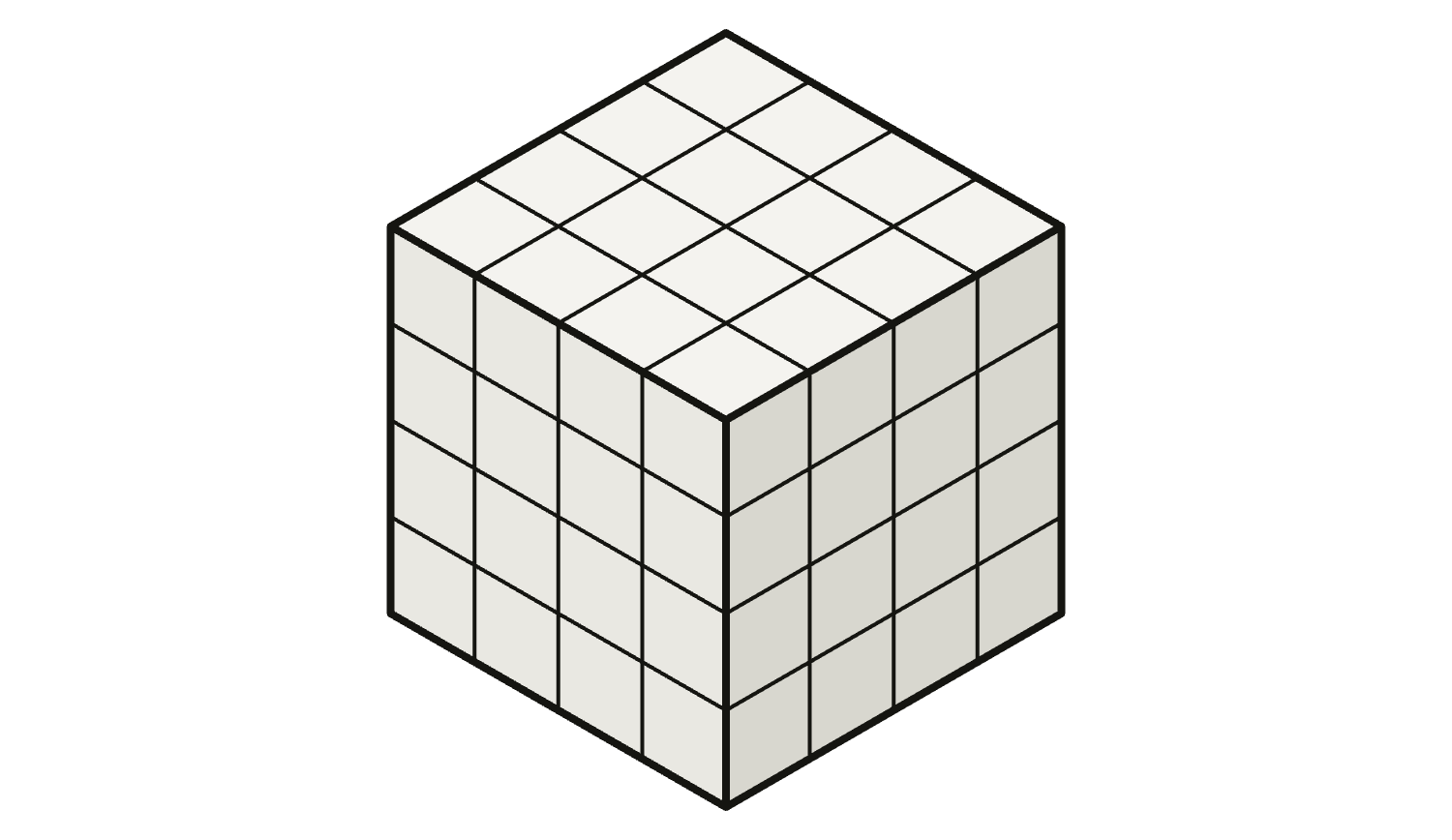
A large cube is made from 64 identical small cubes, arranged in a 4 × 4 × 4 cube.
The top and four side faces of the large cube are painted, but the bottom face is not.
The large cube is then separated into its individual small cubes.
How many small cubes have paint on exactly two faces?
Solution
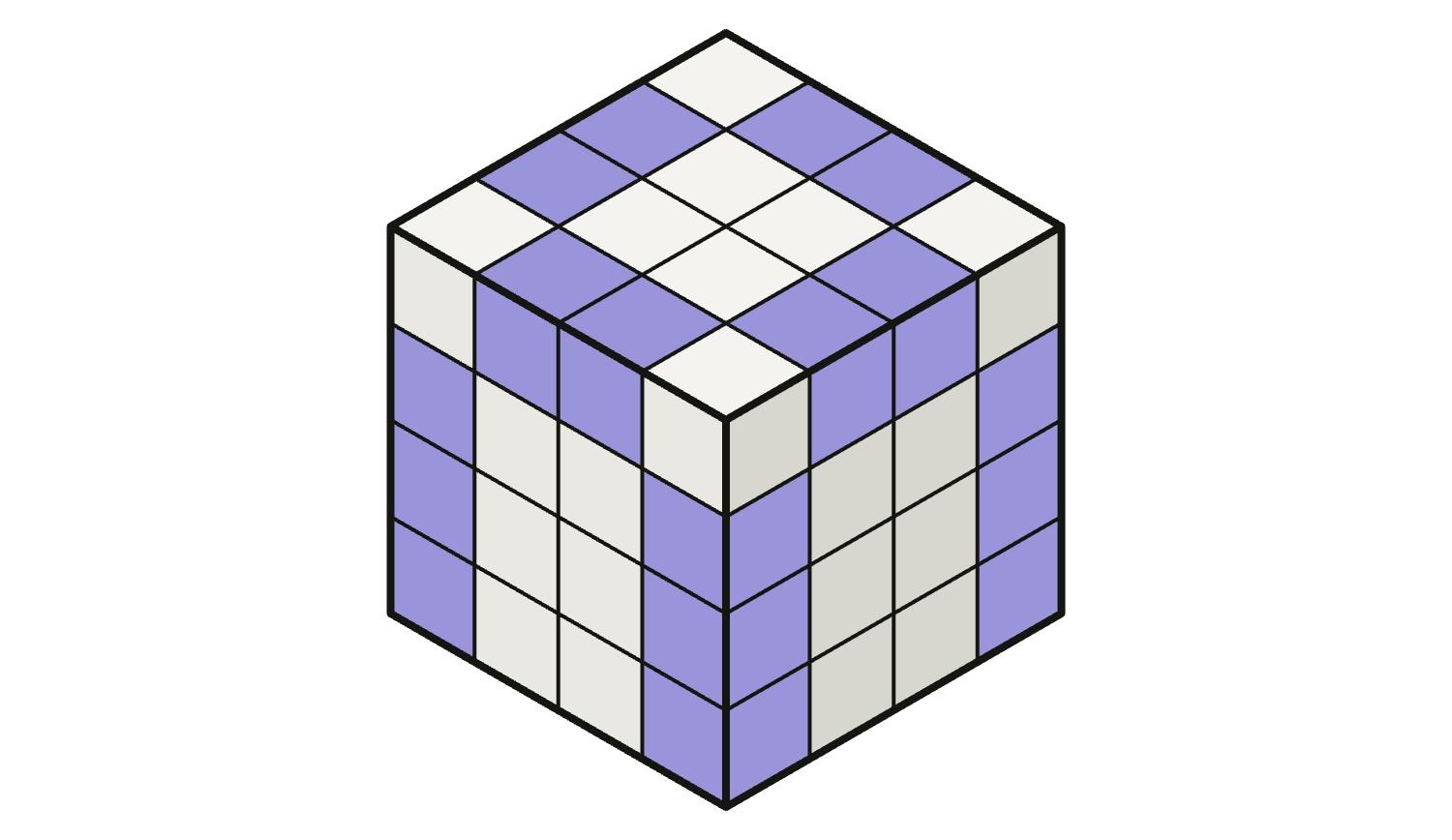
8 cubes along the top edges have exactly two faces painted. The top corners have three painted faces, so they don't count.
12 cubes along the vertical edges, below the top layer, have exactly two faces painted. (Three of these cubes are hidden from view in the diagram.)
Total: 8 + 12 = 20 cubes.
The explorer, ______ account of the journey was published later, travelled alone.
Which word correctly completes the sentence?
Solution
Whose shows possession: the account belongs to the explorer.
The path curved out of sight.
“I wonder what we’ll find,” said Luca, quickening his pace.
“I wonder how we’ll get back,” replied Saira, studying the map.
How do the characters’ attitudes differ?
Solution
Luca quickens his pace, suggesting excitement about the unknown. Saira checks the map and worries about getting back, suggesting caution.
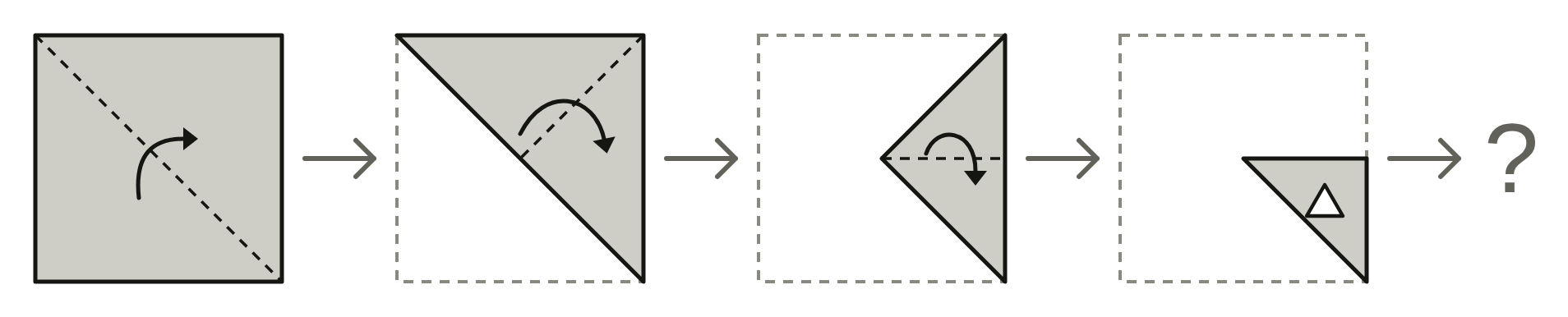
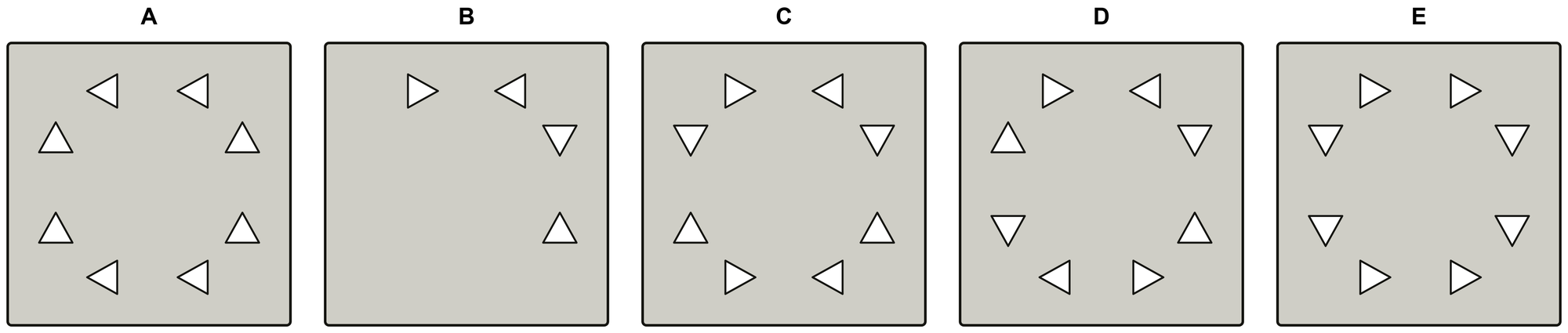
This piece of paper has been folded and then had shapes cut out of it. Which of the images below shows how the paper will look once it has been unfolded?
Solution
The number of layers of paper gives the number of holes. Once folded, the paper has 8 layers, so there are 8 triangles when it is unfolded.
Each fold line acts like a mirror line: each triangle is a reflection of the triangle on the other side of the fold. Picture C is the only one that shows this.
Answers will be published on Wednesday 11 November.
The pages of a book are numbered from 1 to 120. How many times does the digit 1 appear in all the page numbers?
Solution
From pages 1–99, the digit 1 occurs 10 times in the ones position and 10 times in the tens position: 20 times. From 100–120, it occurs 21 times in the hundreds position, 10 times in the tens position and twice in the ones position. Total: 20 + 21 + 10 + 2 = 53.
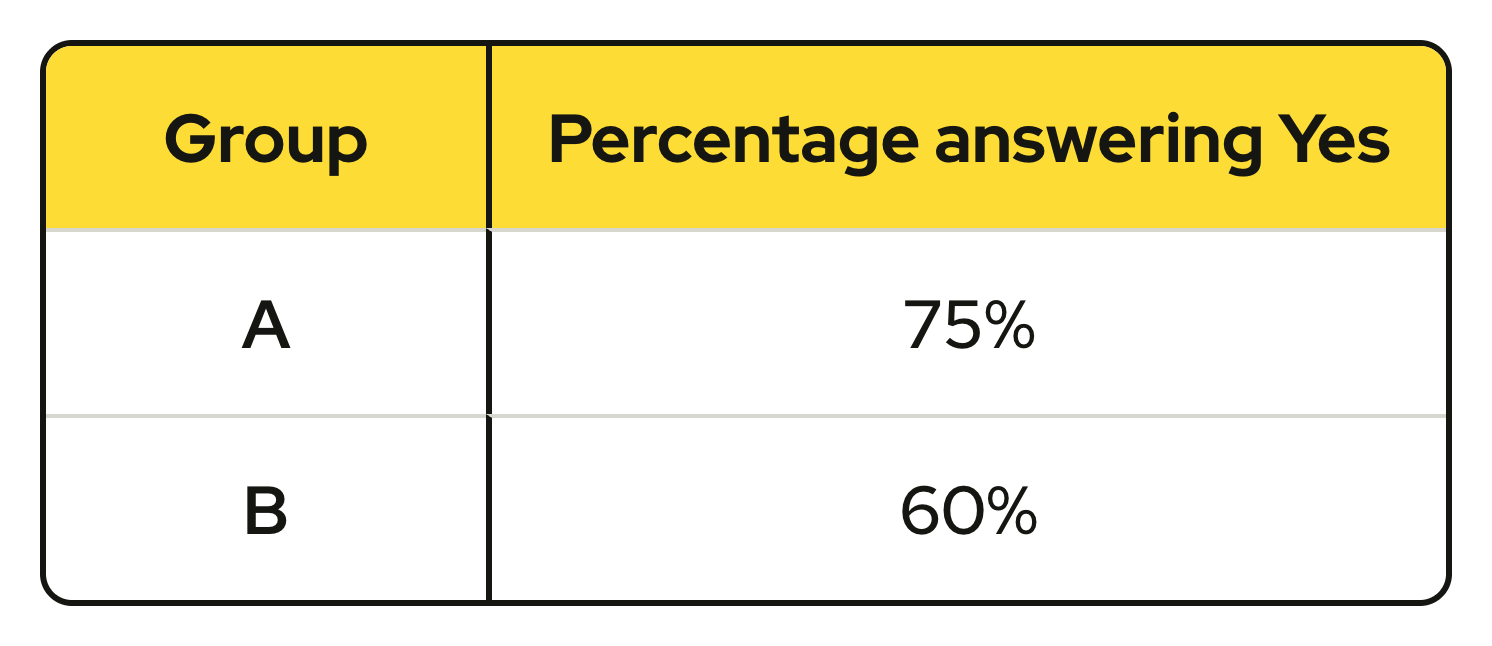
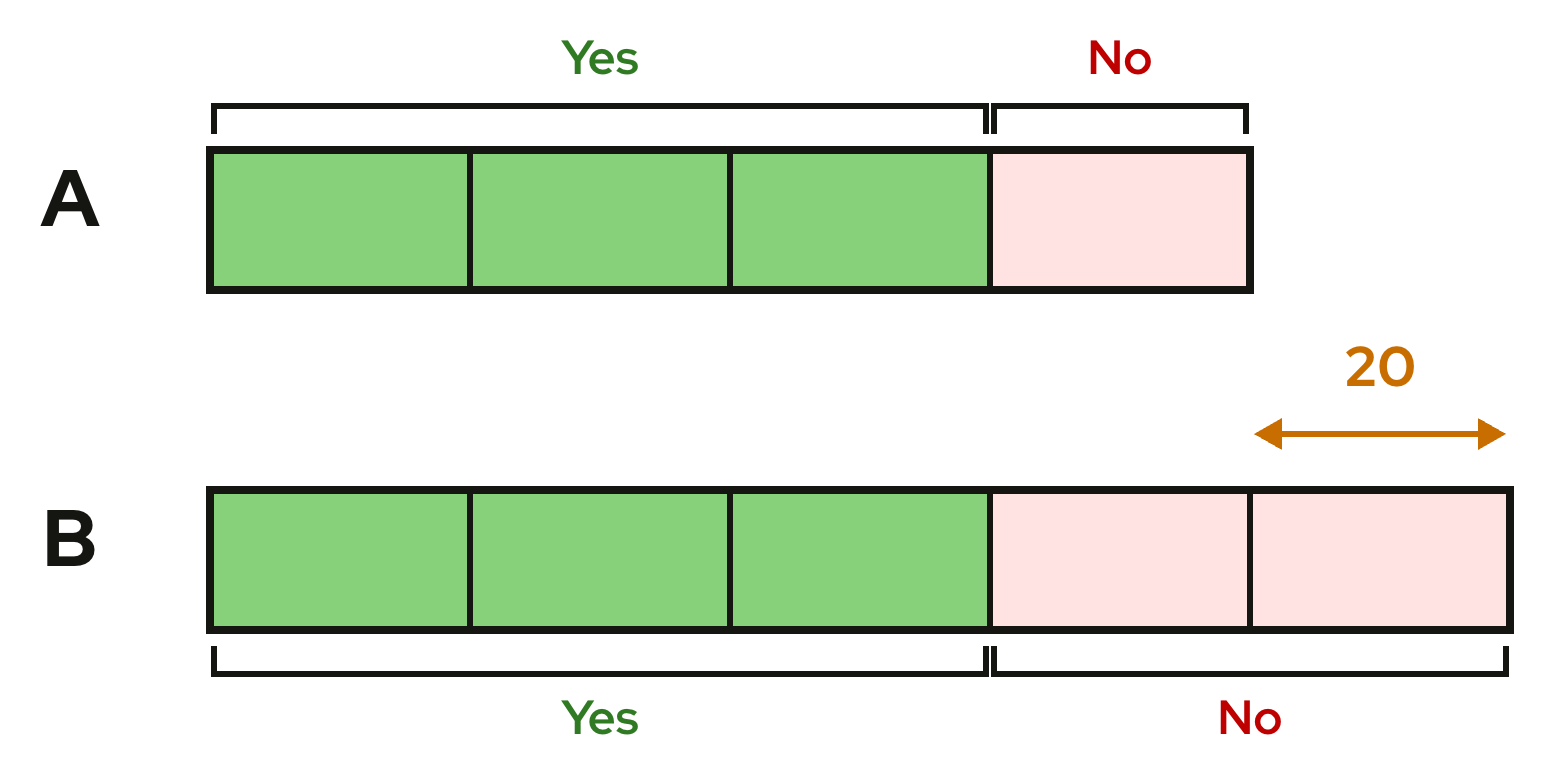
Two groups of pupils answer the same survey. The percentage answering Yes is shown in the table. Exactly the same number answered Yes in both groups. Group B has 20 more pupils than Group A. How many pupils are in Group A?
Solution
The same number of pupils who answered Yes is ¾ of Group A and ⅗ of Group B. Since the number of pupils answering Yes is 3 parts in Group A, Group A is 4 parts. Similarly, Group B is 5 parts. B has 1 part more, which is 20 pupils, so A has 4 × 20 = 80.
A writer has only one uncle.
Which sentence is correctly punctuated?
Solution
The writer has only one uncle, so “who lives in Bristol” is extra information and needs commas on both sides. Without commas, it could suggest the writer has other uncles.
The discovery of an earlier map undermined the explorer’s claim that he had been the first to reach the island.
What effect did the discovery have on his claim?
Solution
To undermine something is to weaken it. The earlier map makes the explorer’s claim less believable.
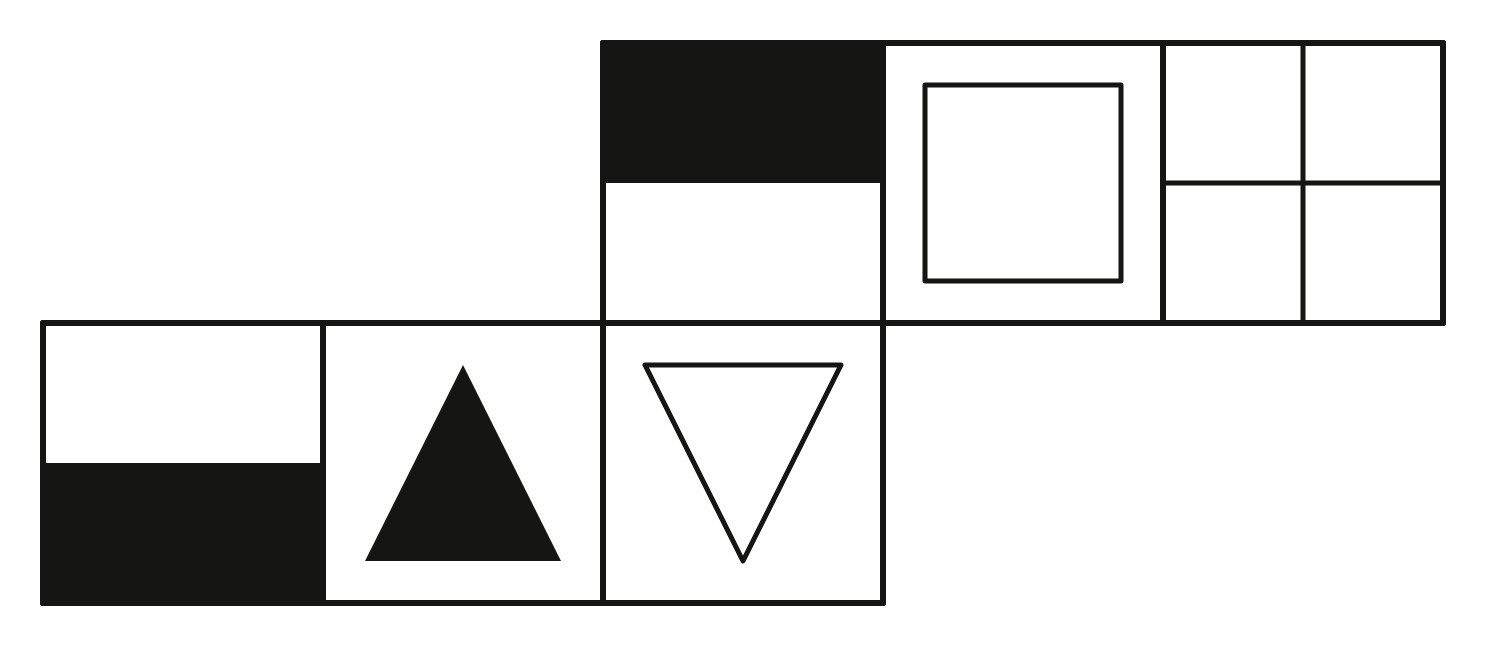
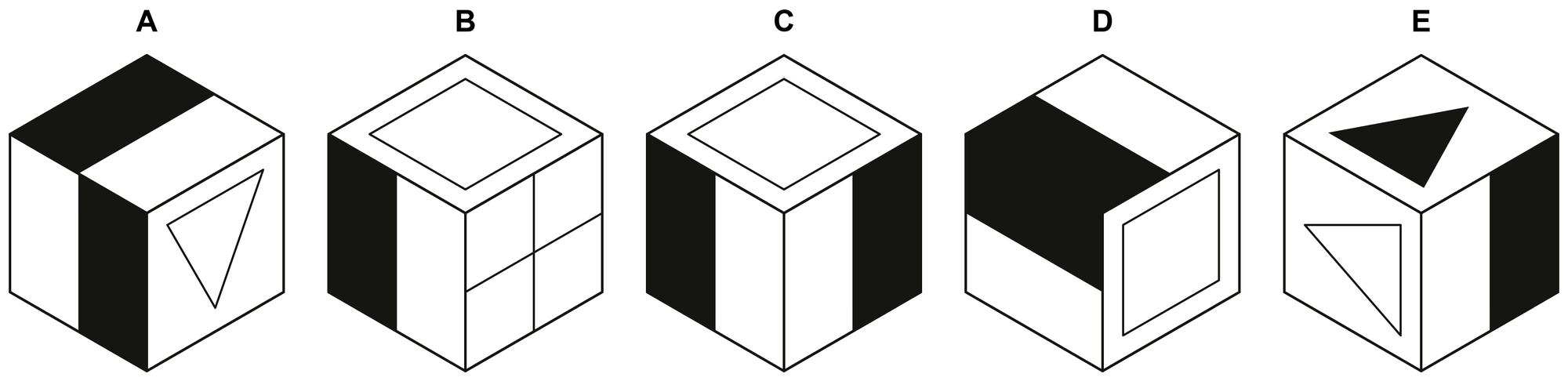
Which cube can be made from this net?
Solution
A, D and E: the faces are shown in the wrong orientation.
B: it shows two faces next to each other that would be opposite each other on the cube.
C is the only cube that can be made from the net.
Answers will be published on Thursday 12 November.
The first five terms of a sequence are 3, 8, 15, 24, 35, … . What is the 20th term?
Solution
The terms follow 1 × 3, 2 × 4, 3 × 5, 4 × 6, 5 × 7, … . The 20th term is 20 × 22 = 440. Equivalently, each term is one less than a square: the 20th is 21² − 1.
At exactly noon, Clock A shows 11:55 am and Clock B shows 12:09 pm. Clock A gains 2 minutes every 30 minutes, while Clock B loses 3 minutes every hour. At what actual time will both clocks next show the same time?
Solution
Clock B starts 14 minutes ahead of Clock A. A gains 4 minutes every hour, while B loses 3, so the gap closes by 7 minutes every hour. It closes in 14 ÷ 7 = 2 hours, at 2:00 pm.
Check: At 1:00 pm, Clock A shows 12:59 and Clock B shows 1:06. At 2:00 pm, both clocks show 2:03.
Which pair of prefixes correctly forms the opposites of legible and relevant, in that order?
Solution
The prefix in- changes to il- before l (illegible) and to ir- before r (irrelevant). Watch the order: the question asks for legible first.
The museum increased its admission prices, but an unexpected repercussion was a sharp fall in visitor numbers.
What does repercussion mean in this context?
Solution
A repercussion is a consequence, often an unwelcome one, that follows from an action. Here, the price rise led to fewer visitors. Despite the sound of the word, it has nothing to do with noise or percussion.
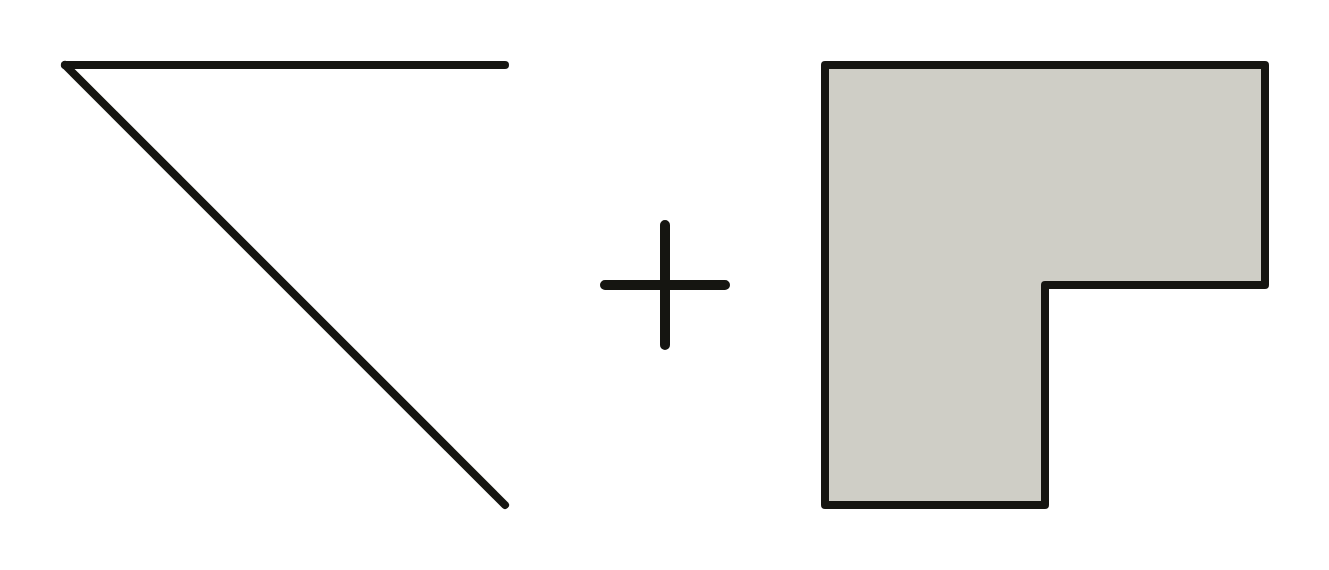
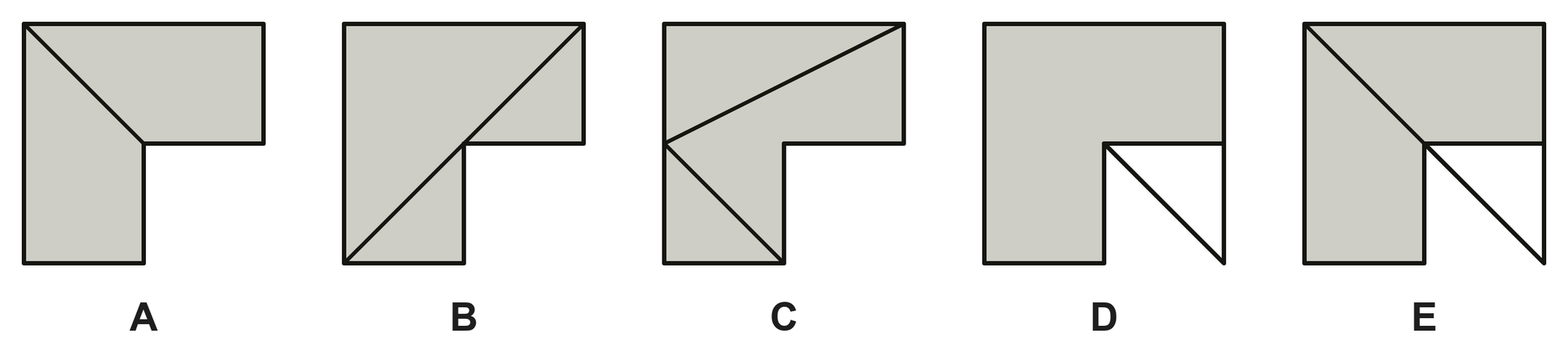
Which image is created by combining the two shapes below? The shapes may have been rotated.
Solution
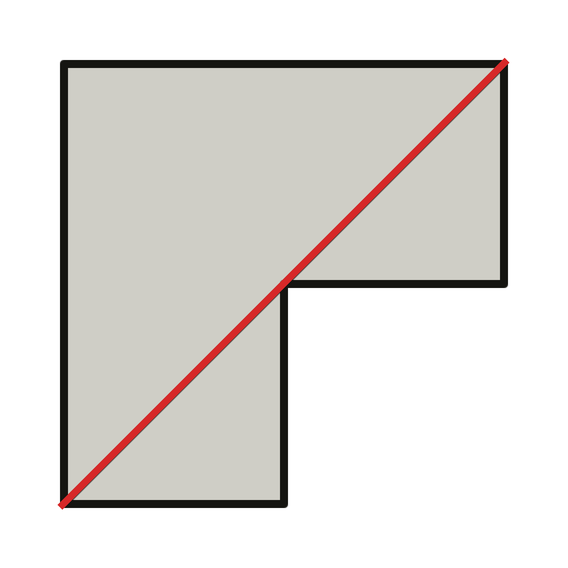
In picture B, the diagonal line of the first shape runs from corner to corner across the L-shape (shown in red), and its other line sits along the top edge of the L-shape.
Answers will be published on Friday 13 November.
A four-digit number has the form 4□7□. What is the largest possible number of this form that is divisible by both 5 and 9?
Solution
Divisible by 5 means it ends in 0 or 5. Divisible by 9 means its digits add up to a multiple of 9. Ending in 0: 4 + □ + 7 + 0 must make 18, so □ is 7, giving 4,770. Ending in 5: 4 + □ + 7 + 5 must make 18, so □ is 2, giving 4,275. The larger is 4,770. (4,875 is divisible by 3, but not by 9.)
Alternatively, make use of the multiple-choice options. The question asks about the largest number, so start with the largest and work down to see if it is a multiple of both 5 and 9. All the options are multiples of 5. Then check which ones add up to a multiple of 9. 4770 is the largest one in the answer choices whose digits add up to a multiple of 9.
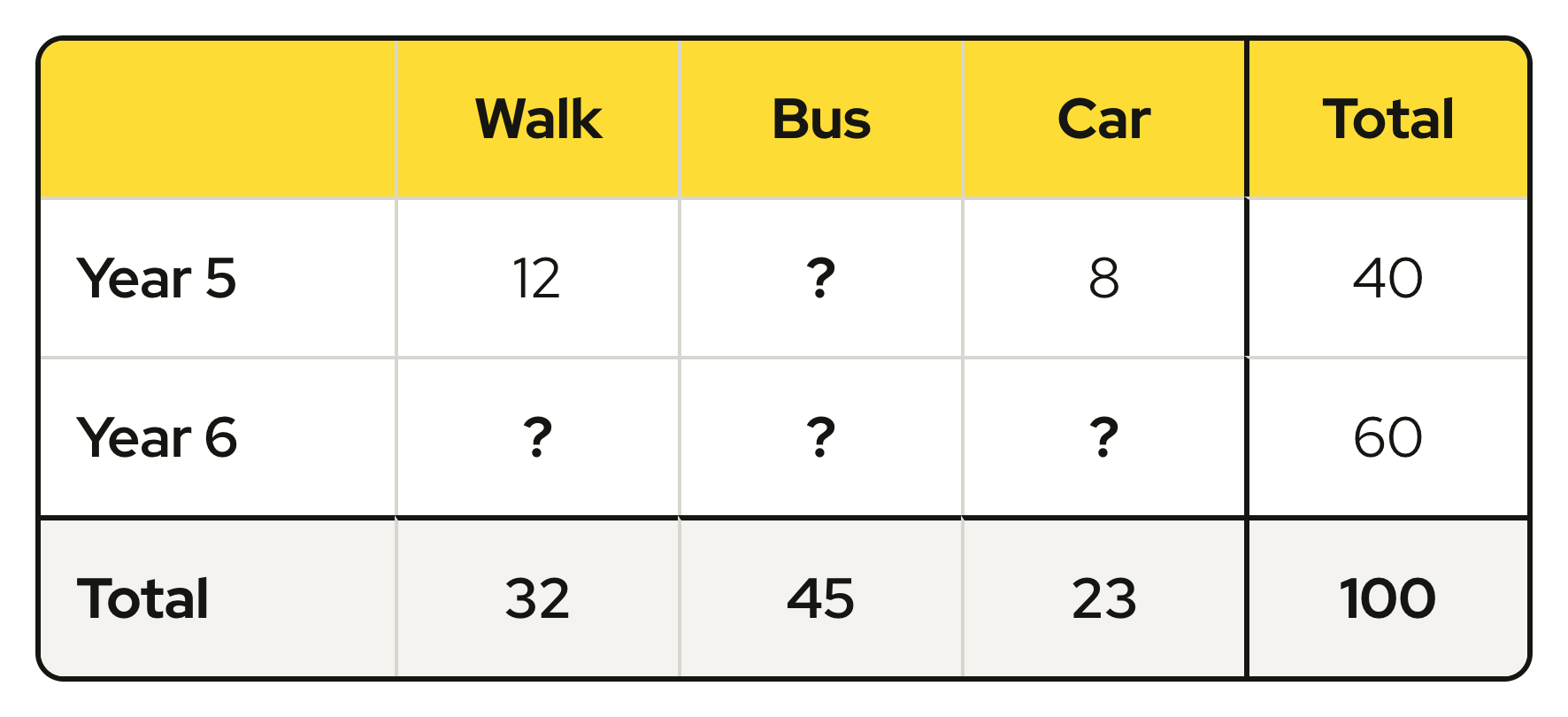
The table shows how pupils in Years 5 and 6 travel to school. What fraction of the Year 6 pupils who do not travel by bus come to school by car?
Solution
Year 6 has 32 − 12 = 20 walkers and 23 − 8 = 15 car travellers. Of the Year 6 pupils who do not use the bus, 20 + 15 = 35 pupils remain. The fraction who come by car is 15/35 = 3/7.
Which sentence is grammatically correct?
Solution
The verb agrees with the main noun, not the nearest noun. The correct forms are: label is, pattern is, results were, colour has and keys are.
A collector claimed that a recently discovered painting must be a forgery because its signature looked different from the artist’s other works. A museum curator pointed out that the artist’s signature had changed considerably throughout his career.
Which conclusion is best supported by the information?
Solution
The different signature might be suspicious, but there is another possible explanation. More evidence would be needed to decide whether the painting is genuine.
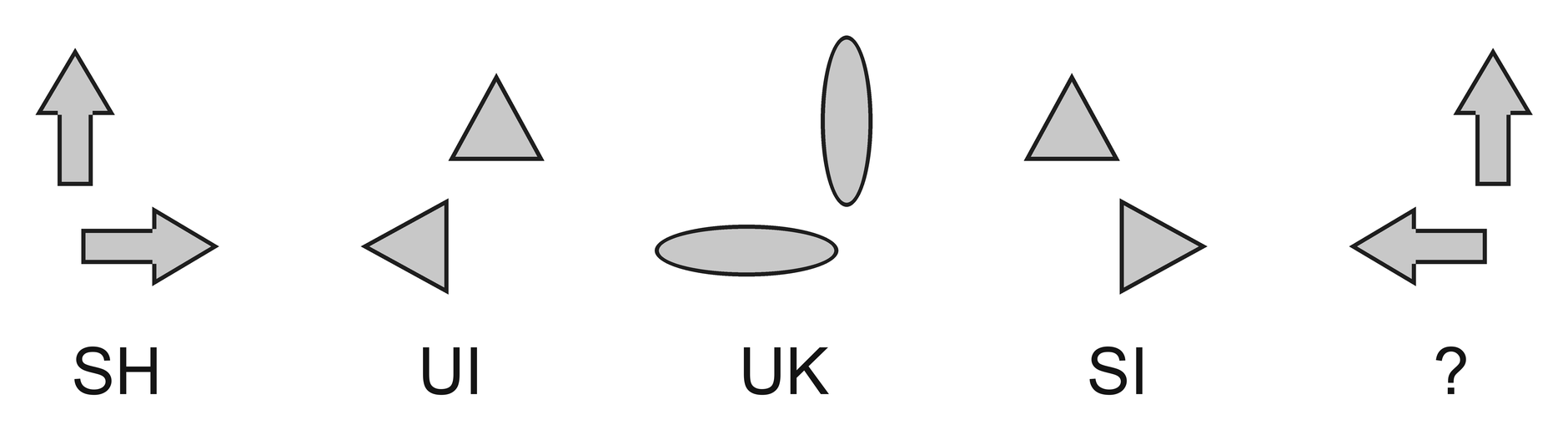
Each letter represents a feature of the image. Which code applies to the final image?
Solution
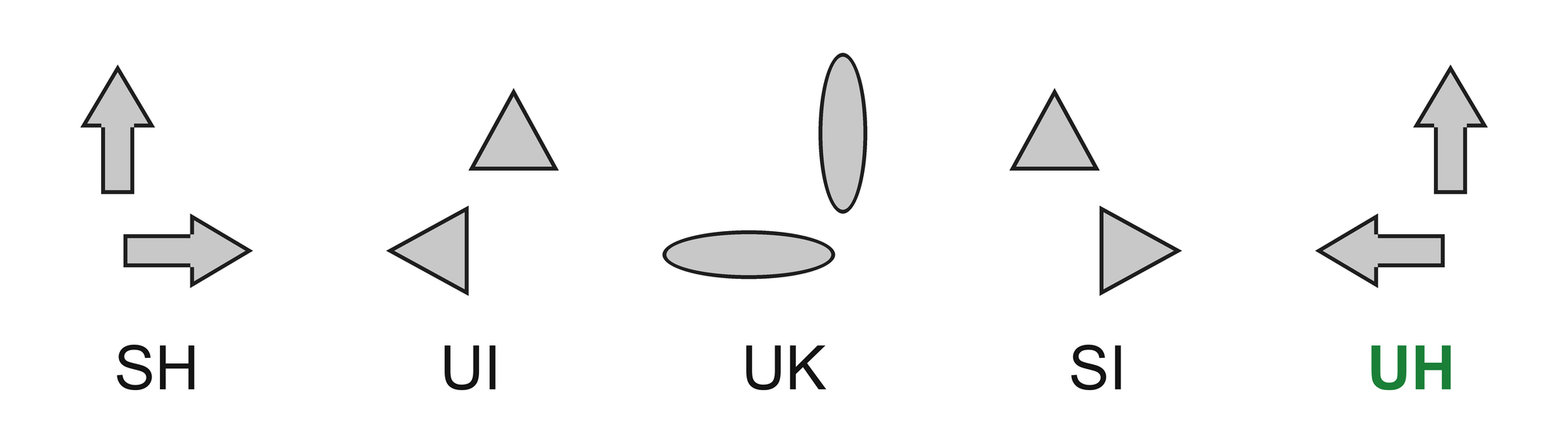
The first letter shows the direction of the two shapes. S: the shapes go from top left to bottom right. U: the shapes go from bottom left to top right.
The second letter shows the type of shape. I: triangles. H: arrows.
In the final image, the arrows go from bottom left to top right, so the code is UH.
Answers will be published on Monday 16 November.
Every correct answer earns a point. Keep going through the three weeks and you could be one of our winners.
1 point
for every correct answer. Five questions a day means up to 75 points across the challenge.
10 of 15
Complete at least 10 of the 15 daily sets to be eligible to potentially win a prize.
Top 10
The 10 qualifying students with the highest total scores win, and anyone tied for 10th place wins too. Every winner receives the same prize.
The prize
Every winner receives a Wonders of Maths branded tote bag, perfect for carrying books to school. The competition is open to Year 6 students in the UK.
Read the full competition rulesA few minutes a day, every weekday until 13 November.
Start Today's Challenge
Kings House, 174 Hammersmith Road,
Hammersmith, London, W6 7JP
07921 559630
2025. All rights reserved.

Kings House, 174 Hammersmith Road,
Hammersmith, London, W6 7JP
Kings House, 174 Hammersmith Road,
07921 559630
2025. All rights reserved.


